
We all have deeds we would rather not see again. Some sins are remembered with regret, while others are forgotten with the passing of time. However, the Day of Judgment is a day when nothing is lost from the record. Every deed will be brought forward, and every person will see what they sent ahead for themselves. The Prophet (SAW) told us about one man whose record will be unlike anything we can easily imagine. 99 scrolls of sins will be presented before him, each one stretching as far as the eye can see. Standing before Allah (SWT), he will be confronted with the full reality of what he had done. At first, his situation appears to leave little room for hope. Yet this remarkable hadith is not simply about the enormity of a person’s sins. It points to something far greater—something about faith, the justice of Allah (SWT), and the mercy that a believer should never underestimate.
What is the hadith of the 99 scrolls?
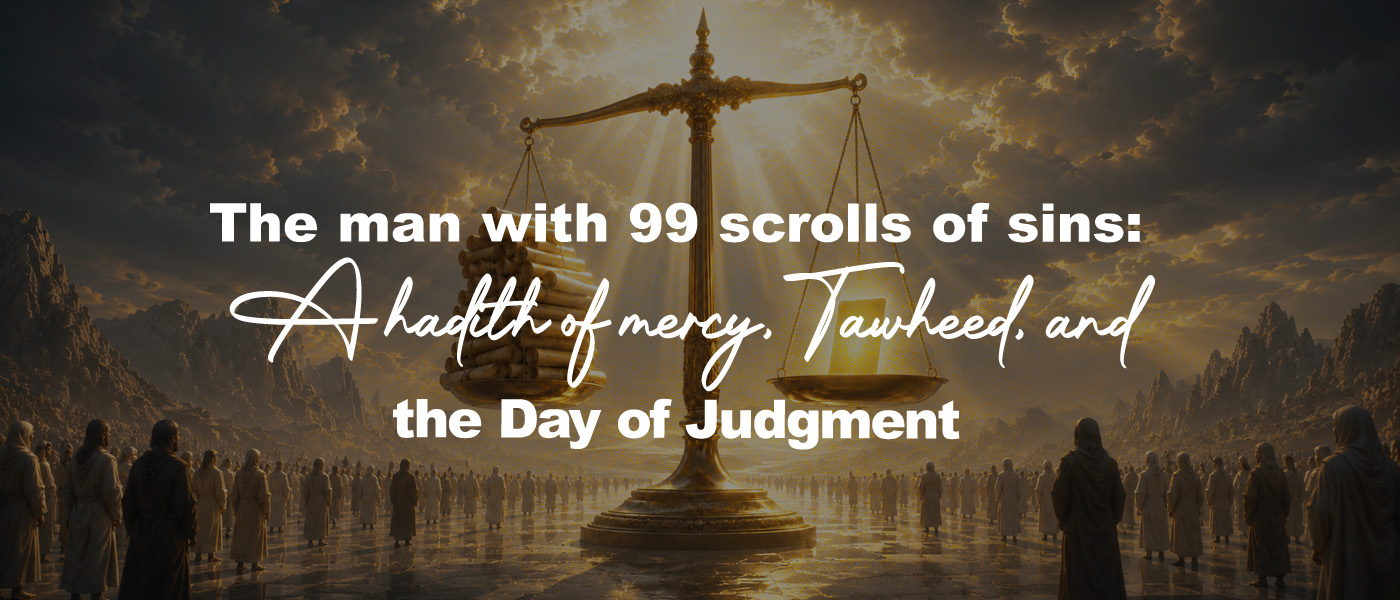
‘Abdullah ibn ‘Amr ibn al-’As (ra) reported that the Messenger of Allah (SAW) said, “Indeed, Allah will bring forth a man from my Ummah before all of creation on the Day of Resurrection. 99 scrolls will be spread out before him, each scroll extending as far as the eye can see.” Then Allah (SWT) will say, “Do you deny anything from this? Have My recording angels wronged you?” He will say, “No, my Lord.” Allah (SWT) will say, “Do you have any excuse?” He will say, “No, my Lord.” Allah (SWT) will say, “Rather, you have a good deed with Us, and you will not be wronged today.”
Then a card will be brought out upon which is written, “I bear witness that there is no deity worthy of worship except Allah, and I bear witness that Muhammad is His servant and Messenger.” Allah (SWT) will say, “Bring forth your weight.” The man will say, “My Lord, what is this card compared with all of these scrolls?” Allah (SWT) will say, “You will not be wronged.” Then the scrolls will be placed on one side of the Scale and the card on another. The scrolls will become light, and the card will become heavy, for nothing can outweigh the Name of Allah.” (Jami at-Tirmidhi)
Lesson #1: The weight of Tawheed
The first and perhaps greatest lessons from this hadith is that extraordinary weight of tawheed, to worship Allah (SWT) alone and to meet Him believing sincerely that none has the right to be worshipped except Him. The man comes forward with 95 scrolls filled with sins, yet the card bearing the testimony la ilaaha ilallah outweighs them all. The hadith shows us that nothing a servant carries is greater than sincere faith in Allah (SWT). But this should not be understood to mean that merely pronouncing the words la ilaaha ilallah makes a person safe regardless of how they live. Many people will have spoken these words, yet The Quran and Sunnah repeatedly warn against hypocrisy, insincerity, and turning away from the commands of Allah (SWT). The testimony of faith has a meaning, and it carries responsibilities. It is a declaration that Allah (SWT) alone deserves our worship, obedience, reliance, hope, fear, and ultimate devotion. This is why the scholars explained that the weight of la ilaalah ilallah is connected to what is present in the heart of the person who says it. The same words may be spoken by many tongues, but they are not necessarily equal in sincerity, certainty, love, submission, and truthfulness. In the case of this man, there was something real and weighty in his tawheed, something known fully to Allah (SWT), that caused this small card to outweigh an enormous record of sin.
Allah (SWT) says in The Quran, “But those objects of worship they invoke besides Him have no power to intercede, except those who testify to the truth knowingly.” (The Clear Quran®, 43:86)
The testimony therefore is not simply a phrase to be repeated, it is a truth to be known, believed, and lived. The believer should come away from this hadith with a renewed appreciation for la ilaaha ilallah. We may say these words every day, but we should never allow familiarity to make them feel ordinary. They are the foundation of Islam, the reason the messengers were sent, and, when carried with genuine faith, the heaviest thing a servant can possess.
Lesson #2: Allah (SWT) will never wrong anyone
Another powerful lesson in this hadith is the absolute justice of Allah (SWT). Before the man is judged, Allah (SWT) asks him whether he denies anything written in his scrolls and whether the recording angels have wronged him. The man admits that the record is accurate. He has no excuse, and nothing has been added to his account unfairly. This detail matters because the Day of Judgment will not be a day of confusion, guesswork, or injustice. Every deed will be accounted for with complete accuracy. Allah (SWT) says, “And the record of deeds will be laid open, and you will see the wicked in fear of what is written in it. They will cry, ‘Woe to us! What kind of record is this that does not leave any sin, small or large, unlisted?’ They will find whatever they did present before them. And your Lord will never wrong anyone.” (The Clear Quran®, 18:49)
The hadith emphasizes this again when Allah (SWT) tells the man, “You will not be wronged today.” Even when the man himself cannot imagine how a single card could possibly matter beside 99 scrolls of sins, Allah (SWT) assures him that the weighing will be perfectly just. Nothing will be overlooked, nothing will be exaggerated, and no person will receive anything other than what Allah (SWT) decrees with perfect knowledge and justice. For the believer, this should create both fear and reassurance. It should make us careful about our deeds because nothing escapes Allah’s (SWT) knowledge, even what other people never see. At the same time, it should comfort us because no sincere act of obedience, no hidden good deed, and no genuine faith in the heart will ever be lost with Allah (SWT). What people fail to notice, Allah (SWT) knows completely.
Allah (SWT) says in The Quran, “So whoever does an atom’s weight of good will see it. And whoever does an atom’s weight of evil will see it.” (The Clear Quran®, 99:7-8)
The man with the 99 scrolls us that Allah’s (SWT) judgment is not based merely on what appears overwhelming to us. Allah (SWT) knows the true weight of every deed and the reality of what lies within every heart. On that Day, His justice will be complete, and not even the smallest good or evil will be forgotten.
Lesson #3: Never despair of the rahmah of Allah (SWT)
One of the most striking parts of this hadith is how hopeless the man’s situation appears from his own perspective. He sees 99 scrolls filed with sins, admits that they are all his, and has no excuse to offer. When he is told that there is still a good deed recorded for him, even he seems unable to imagine how it could possibly make a difference. Yet the outcome is not what he expects. This teaches us something essential about our relationship with Allah (SWT), a believer should never allow the number or seriousness of their sins to lead them to despair of His mercy. Despair can make a person believe that repentance is pointless, that they have gone too far, or that there is no longer any path back to Allah (SWT).
The Quran rejects that kind of hopelessness in some of its most comforting words, “Say, O Prophet, that Allah says, ‘O My servants who have exceeded the limits against their souls! Do not lose hope in Allah’s mercy, for Allah certainly forgives all sins. He is indeed the All-Forgiving, Most Merciful.’” (The Clear Quran®, 39:53)
However, we must keep in mind that this doesn’t mean sins should be taken lightly or that a person should deliberately persist in disobedience while assuming that mercy will erase everything in the end. True hope in Allah (SWT) is not carelessness. It is what brings a person back to Him. It encourages repentance, humility, obedience, and the determination to keep returning to Allah (SWT) no matter how many times one has fallen. The man in this hadith reminds us that we do not know the full measure of Allah’s (SWT) mercy, nor do we always understand the true weight of what is in a person’s heart. A servant may look at their past and see nothing but failure, while Allah (SWT) knows the sincerity, faith, repentance, and good that others cannot see.
As long as a person is alive, the door of repentance remains open, and no believer should decide for themselves that Allah (SWT) will not forgive them. The lesson, then, is not to feel safe because of our sins, but neither is it to be crushed by them. We fear their consequences, we repent from them, and we continue turning back to Allah (SWT) with hope. The believer walks between fear and hope, knowing that Allah (SWT) is severe in punishment, but also knowing that His mercy is greater than we can comprehend.
Lesson #4: Your sins are always recorded, even when you may forget them
The 99 scrolls are a sobering reminder that our deeds do not disappear simply because we forget them. A person may commit a sin and move on from it, perhaps barely thinking about it again, but nothing is lost with Allah (SWT). What we say, what we do, and what we choose is known and recorded. Allah (SWT) says in The Quran, “[…] while you are certainly observed by vigilant, honourable angels, recording everything.” (The Clear Quran®, 82:10-12)
In the hadith, the man does not dispute what is written in his scrolls. When Allah (SWT) asks him whether recording angels have wronged him, he answers, “No my Lord.” The record is accurate. Every entry belongs to him, and on that Day he is made to face what he had sent ahead. Allah (SWT) describes this reality elsewhere in The Quran, “On the Day Allah resurrects them all together, He will then inform them of what they have done. Allah has kept account of it all, while they have forgotten it. For Allah is a Witness over all things.” (The Clear Quran®, 58:6)
Those few words should make us reflect. We forget much of what we do. We forget careless words, moments of anger, sins committed in private, and wrongs that once seemed insignificant. However, forgetfulness does not remove them from the record. This is one of the reasons repentance is such a mercy. Allah (SWT) does not command us to live our lives constantly trying to remember every mistake we have ever made. Rather, He calls us to turn back to Him sincerely, to seek His forgiveness, to leave sin behind, and to correct what we can. The believer regularly asks Allah (SWT) for forgiveness not only for the sins they remember, but also for those they have forgotten. At the same time, this lesson should make us more conscious of what we are placing into our own record each day. The scrolls of the Hereafter are being written now. Every sincere prayer, every act of kindness, every word of remembrance, and every moment in which we resist something displeasing to Allah (SWT) is also recorded.
The hadith therefore gives us a reason to examine ourselves before the Day comes when the record is opened before us. What has already been written can become a reason to repent, and what remains of our lives is still an opportunity to fill our record with deeds we will be grateful to see again.
Lesson #5: The Mizan is a reality of the Day of Judgment
The hadith of the 99 scrolls gives us a vivid glimpse of one of the realities of the Day of Judgment and that is the Mizan, the Scale. The Prophet (SAW) tells us that the man’s scrolls will be placed on one side and the card on the other. This is not merely a figure of speech, but part of what Allah (SWT) has revealed concerning the events of the Hereafter. Allah (SWT) says in The Quran, “We set up the scales of justice for the Day of Judgment, so no soul will be wronged in the least. And even if a deed is the weight of a mustard seed, We will bring it forth. And sufficient are We as a vigilant Reckoner.” (The Clear Quran®, 21:47)
The Quran repeatedly speaks about the weighing that will take place on that Day. Allah (SWT) says, “The weighing on that Day will be just. As for those whose scale will be heavy with good deeds, only they will be successful.” (The Clear Quran®, 7:8)
For the believer, this is a reminder that the Day of Judgment is not an abstract idea. It will contain real events that Allah (SWT) and His Messenger (SAW) have informed us about and that is the resurrection, the gathering, the records of deeds, the reckoning, and the Scale. We believe in these matters because they come to us through revelation, even though their full nature belongs to the unseen. The Mizan also reminds us of the seriousness of the life we are living now. The deeds we perform today are not without consequence. A day is coming when the record will be opened and the weighing will take place. What seems distant now will then be directly before us. This is why belief in the aakhirah is meant to shape the way a Muslim lives in the present. Remembering the Scale encourages us to take our deeds seriously, to repent when we fall short, and to prepare for the day when every person will stand before Allah (SWT) and see the true outcome of what they sent ahead.
Preparing for the day we meet Allah (SWT)
The hadith of the 99 scrolls is one that should stay with us long after we finish reading it. It reminds us that our deeds are being recorded, that we will stand before Allah (SWT), and that the reckoning of the aakhirah is real. At the same time, it shows us the immense weight of sincere Tawheed and the vastness of Allah’s (SWT) mercy. There is balance in this hadith that every believer needs. We should never become so comfortable with the mercy of Allah (SWT) that we begin to treat sin lightly, but neither should we become so overwhelmed by our failures that we lose hope in Him. We repent, seek forgiveness, strive to obey Allah (SWT), and continue returning to Him whenever we fall short. Perhaps one of the most powerful moments in the entire narration is when the man looks at the small card and asks what it could possibly do against 99 scrolls. From what he can see, there is no comparison. Yet Allah (SWT) knows the true weight of what that card represents. What appears insignificant to the servant is not insignificant with his Lord.
That should make us look differently at the words la ilaaha ilallah. They are not simply words we inherited, nor are they merely something we repeat with the tongue. They are the foundation of our faith, a testimony to be understood, believed sincerely, and reflected in the way we worship and live. One day, every one of us will see our own record. We do not know what it will contain, nor do we know which deeds Allah (SWT) will accept from us and cause to weigh heavily on our behalf. What we do know is that the door of repentance is open while we are alive, that no sincere good deed is lost with Allah (SWT), and that the believer should continue preparing to meet Him with both fear and hope.
Duas
May Allah (SWT) forgive our sins, those we remember and those we have forgotten, those committed openly and those committed in private.
May He (SWT) make la ilaaha ilallah firm upon our hearts and tongues, grant us sincere Tawheed, accept our repentance, and protect us from meeting Him while carrying sins we refused to leave behind.
May Allah (SWT) make our records pleasing to us on the Day of Judgment, make our scales heavy with righteous deeds, overlook our shortcomings, and judge us with His mercy and perfect justice. May He (SWT) grant us a good ending, keep us steadfast upon faith until our final breath, and gather us among those who are forgiven and admitted into Jannah without disgrace or punishment.
Ameen, ya Rabb al-Alameen!