
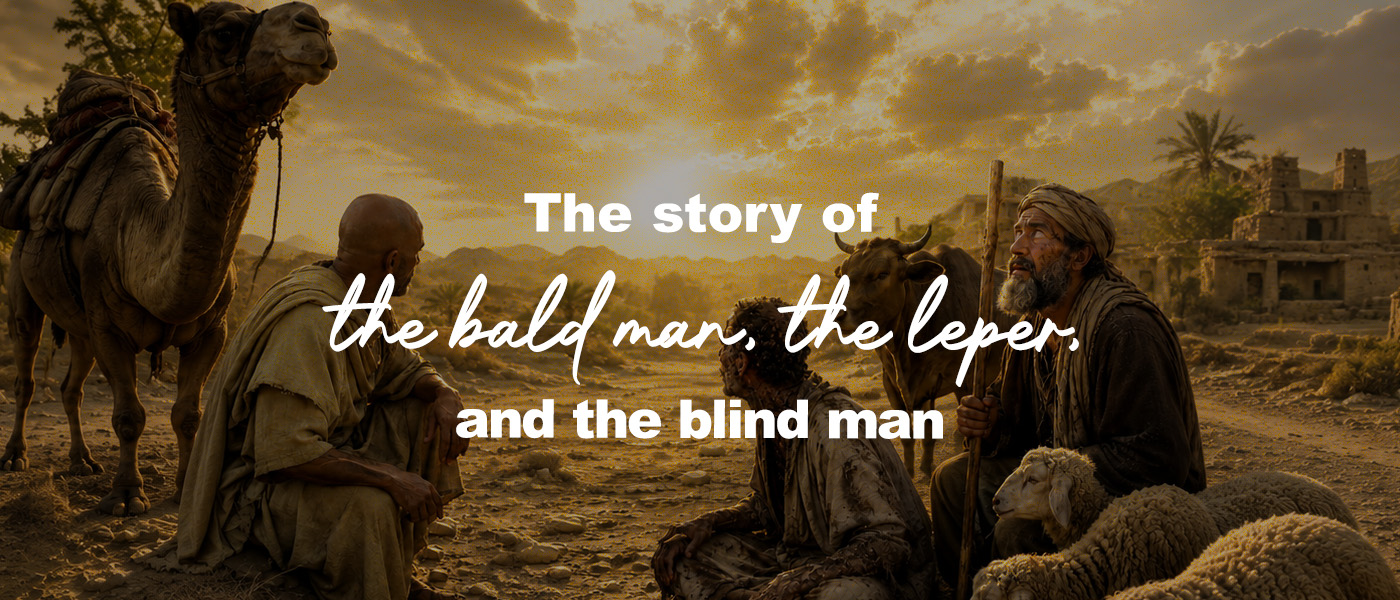
Among the remarkable stories narrated by the Prophet Muhammad (SAW) is the account of three men from the Children of Israel which consisted of a man afflicted with leprosy, a bald man, and a blind man. The hadith, authentically reported in Sahih Bukhari and Sahih Muslim, is often remembered as a lesson about gratitude. Yet its meaning goes much deeper. It is a story about how human beings respond when hardship is removed, how easily blessings can become ordinary in our eyes, and how comfort can reveal what difficulty once concealed within the heart. The Prophet (SAW) said, “There were three men among the Children of Israel: a leper, a bald man, and a blind man. Allah willed to test them, so He sent an angel to them.”
Each man was asked what he desired most. The man afflicted with leprosy longed for healthy skin and relief from the condition that caused people to avoid him. The bald man wished for beautiful hair, while the blind man asked that Allah (SWT) restore his sight so that he could see people again. Allah (SWT) granted each of them what he desired, and then granted them wealth as well. Their livestock multiplied until each possessed an abundance that would once have seemed unimaginable.
However, receiving the blessing was not the end of the test. It was the beginning of another one. The angel later returned to each man in a condition resembling the hardship he himself had once endured and asked for assistance. Suddenly, the test was no longer about patience during suffering. It was about gratitude after suffering had passed. Would they remember who they had been? Would they acknowledge that their health and wealth had come from Allah (SWT)? And would the mercy they had received make them merciful toward someone standing before them in need? Two of the men failed that test. They denied their former condition and spoke as though their wealth had always belonged to them.
The formerly blind man responded differently. He said, “I was blind, and Allah restored my sight to me. I was poor, and Allah made me wealthy.” He remembered both his weakness and the One who had changed his circumstances. Because he remembered the source of his blessing, he was willing to share it freely. That contrast lies at the heart of this hadith. It is possible to remember Allah (SWT) intensely while we are gathering for a blessing and then slowly forget Him once that blessing becomes part of everyday life.
A person may once have begged Allah (SWT) for health, employment, marriage, children, security, or relief from a particular hardship, only for those answered prayers eventually to feel ordinary. The danger is not simply forgetting the hardship itself. The greater danger is forgetting what the hardship once taught us about our dependence upon Allah (SWT). The story of the blind man, the leper, and the bald man therefore forces us to ask a difficult question: are we still as conscious of Allah (SWT) after receiving what we once desperately asked Him for? Their story teaches us that hardship is a test, but ease is also a test, and sometimes the test of abundance is more revealing than the test of deprivation.
1. A blessing can be just as much a test as a hardship
The most important lesson in this hadith is that the test did not end when the three men were healed. In reality, their healing marked the beginning of a second and perhaps more subtle test. During hardship, a person is often acutely aware of his need for Allah (SWT). Sickness, poverty, and weakness strip away many illusions of self-sufficiency, but once the difficulty is removed, that awareness can fade. The heart may begin to treat what was once desperately prayed for as something normal, expected, or even deserved. Allah (SWT) says, “Every soul will taste death. And We test you O humanity with good and evil as a trial, then to Us you will all be returned.” (The Clear Quran®, 21:25)
We often recognize hardship as a test because it hurts. What we do not always recognize is that health, wealth, beauty, influence, and security are also tests. The question is simply different. In hardship, we must ask ourselves, will you remain patient and faithful? In ease, the question becomes, will you remain grateful and humble? The three men were not ultimately distinguished by what Allah (SWT) gave them. All three received extraordinary blessings. They were distinguished by what those blessings did to their hearts.
2. Gratitude requires us to remember who we were before the blessing
When the angel returned, he did not merely ask the men for charity. He reminded them of their past. He approached each one in a condition resembling what that man had once experienced. The test therefore involved memory. The formerly blind man passed because he remembered. He said, “I was blind, and Allah restored my sight to me. I was poor, and Allah made me wealthy.” There is extraordinary humility in those words. He did not attempt to distance himself from his former weakness. He did not feel embarrassed by the person he used to be. Instead, he allowed his past to remind of Allah’s (SWT) favor. The other two men responded very differently. They effectively rewrote their own history. They denied what they had once been and spoke as though their wealth had always belonged to them. Their problem was therefore deeper than stinginess. It was a kind of spiritual forgetfulness. Once they forgot their former need, they also forgot the One who had relieved that need.
This is why remembering our past can itself be an act of gratitude. A person who remembers the days when he had less is less likely to look down upon those who still have less. A person who remembers what illness felt like may become more compassionate toward the sick. A person who remembers loneliness may become gentler with those who are alone. Our past difficulties can remain a source of mercy long after Allah (SWT) has removed them.
3. True gratitude is not something we say, it changes how we treat people
All three men could have verbally claimed to be thankful. The test, however, was not whether they could say alhamdulillah. The test was whether gratitude had changed their behavior. The formerly blind man told the angel, “Take whatever you wish and leave whatever you wish. By Allah, I will not make things difficult for you today regarding anything you take for the sake of Allah.” His gratitude became generosity. That is a profound standard by which to measure our own thankfulness. It is allowing those blessings to become instruments of obedience. If Allah (SWT) gives wealth, gratitude should appear in generosity. If Allah (SWT) gives influence, gratitude should appear in justice. If Allah (SWT) gives health, gratitude should appear in worship and service. Allah (SWT) says, “They made for him whatever he desired of sanctuaries, statues, basins as large as reservoirs, and cooking pots fixed into the ground. We ordered: ‘Work gratefully, O family of David!’ Only a few of My servants are truly grateful.” (The Clear Quran®, 34:13)
The verse connects gratitude with action. The most convincing evidence that we appreciate a blessing is not how beautifully we speak about it, but what we do with it.
4. One of the dangers of success is beginning to believe that we were always this way
There is something psychologically revealing about the responses of the first two men. Their circumstances changed so dramatically that they eventually began speaking as though their new life had always been their life. When reminded of their former condition, they rejected the description and claimed that their wealth had been inherited. Their blessings had become so familiar that dependence had been replaced by entitlement. This is a danger that can appear in many forms. A person who once struggled financially may eventually begin to judge the poor. Someone who once knew very little may become impatient with beginners after gaining knowledge. A person who was once overlooked may begin looking down upon others after receiving status. Someone who once begged Allah (SWT) for an opportunity may later begin behaving as though that opportunity came purely through personal ability.
The Quran describes a similar attitude in the story of Qarun, who said of his wealth, “He replied, ‘I have been granted all this because of some knowledge I have.’ Did he not know that Allah had already destroyed some from the generations before him who were far superior to him in power and greater in accumulating wealth? There will be no need for the wicked to be asked about their sins.” (The Clear Quran®, 28:78) The problem is not acknowledging effort, skill, or hard work. Islam does not deny human effort. The problem begins when the servant notices the means and forgets the One who created the means, opened the doors, gave the ability, and allowed the effort to succeed.
The believer should therefore be able to look at every major blessing in his life and still say sincerely, “There was a time when I did not have this, and Allah (SWT) gave it to me.”
5. How we treat the vulnerable may reveal whether we truly understand Allah’s (SWT) mercy toward us
The angel approached the men not as someone powerful, but as someone vulnerable. He came in need, appearing in a condition that should have awakened their memories and compassion. That detail matters. Allah (SWT) had once shown mercy to these men when they themselves were weak. Their test was whether receiving mercy would make them merciful. The formerly blind man understood this naturally. When he saw someone in need, he did not see a stranger whose problem had nothing to do with him. He saw something of his own former self. That memory opened his hand. This is one of the deepest effects that hardship should leave upon a believer. Suffering should not merely be something we celebrate escaping from. If Allah (SWT) allows us to emerge from it, it should enlarge our capacity to recognize the suffering of others.
The Prophet (SAW) said, “Those who are merciful will be shown mercy by the Most Merciful.” (Jami ‘at-Tirmidhi) Perhaps one of the questions this hadith leaves us with is not simply, “Have I thanked Allah for what He has given me?” but something more searching such as, “has receiving Allah’s (SWT) mercy made me more merciful to other people?” If the answer is yes, then the blessing has reached beyond our hands and entered our hearts.
What will your blessings say about you?
The hadith of the blind man, the leper, and the bald man leaves us with a sobering truth that blessings do not only improve our circumstances, they expose the condition of our hearts. The same shift can produce humility in one person and entitlement in another. The difference is not in the blessing itself, but in whether the person continues to see it as a form of Allah (SWT). For that reason, gratitude should never be reduced to words alone. It is a way of seeing. It means remembering that whatever we possess could have been withheld, whatever difficulty was removed could have remained, and whatever doors opened for us were opened by Allah (SWT). That awareness keeps the heart soft and prevents success from turning into pride.
The hadith also teaches us to look different at the people we encounter. The person standing before us in need may resemble someone we once were, or someone we could easily have become. If Allah (SWT) has carried us through hardship, then perhaps part of the purpose of that experience is that we become more compassionate toward those still living through theirs. In the end, the three men were not judged by how much they possessed, but by what their possessions revealed about them. That is a question worth carrying within us that when Allah (SWT) changes our circumstances for the better, do those blessings bring us closer to Him, or do they slowly make us forget how much we still depend upon Him?
Dua
O Allah! Make us among those who are grateful for Your blessings, mindful of Your favor, and conscious of all that You have bestowed upon us.
O Allah! Do not allow Your blessings to become a cause of heedlessness toward You or pride over Your creation. Grant us humble hearts, grateful tongues, and generous hands.
O Allah! Keep us mindful of Your favor upon us, and make everything You have given us a means of obeying You and showing mercy to Your servants.
Ameen, ya Rabb!