
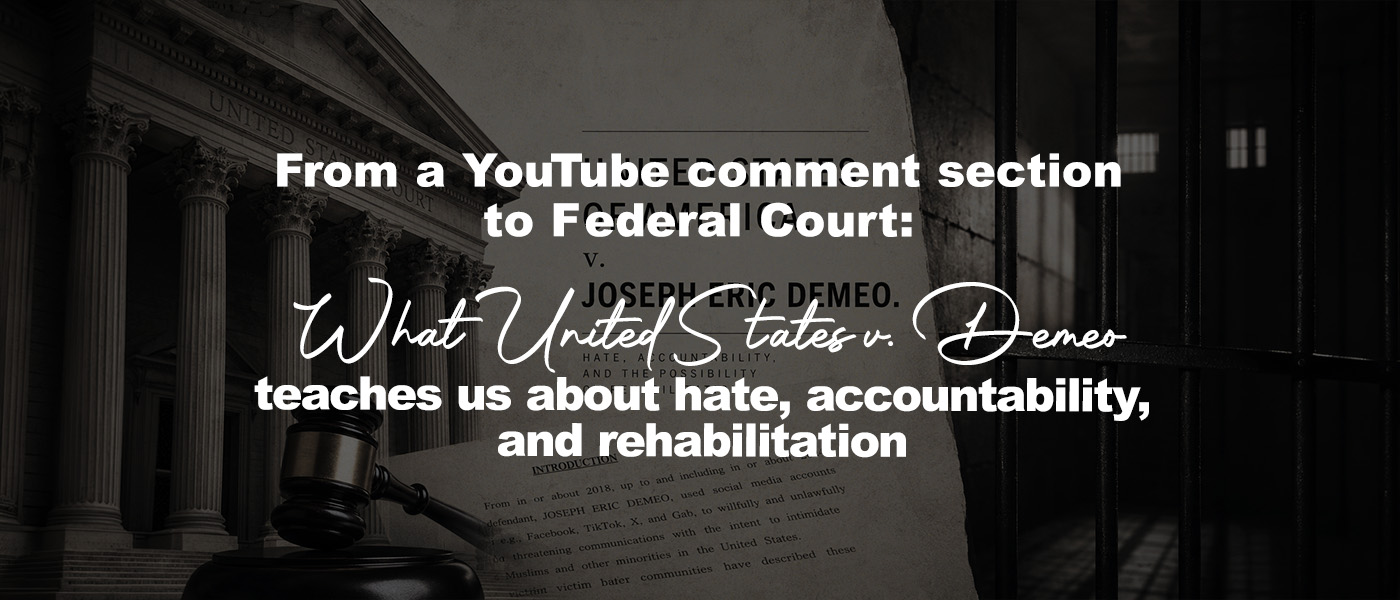
A federal court’s refusal to dismiss 19 criminal counts arising from alleged online threats against Muslims and other minorities raises a larger question: How do we confront hatred before it becomes violence, and how do we pursue genuine transformation after someone enters the criminal justice system?
Hatred rarely begins with handcuffs, an indictment, or a prison sentence. It begins earlier, in the stories people are taught, the falsehoods they accept, the communities they learn to fear, and the language they gradually permit themselves to use. Sometimes that language remains cruel but constitutionally protected. Sometimes it crosses into conduct that the law recognizes as a criminal threat. The allegations in United States v. Demeo shows how quickly that boundary can become the subject of a federal prosecution. The case also presents a challenge that extends beyond one defendant or one YouTube account. When a person allegedly speaks of exterminating entire religious and ethnic communities, how should society respond? What might have interrupted that hatred before it reached the attention of federal investigators? And when people accused or convicted of such conduct enter prison, will incarceration merely contain them, or will anyone undertake the difficult work of transformation?
For Islam in Prison, those questions are inseparable from our mission. Protecting Muslims from hatred and supporting Muslims behind bars are not competing responsibilities. Both are part of building a society grounded in dignity, accountability, knowledge, mercy, and justice.
What the federal indictment alleged
According to the opinion and order issued by the U.S. District Court for the Middle District of Florida, Joseph Eric Demeo allegedly commented on 22 separate YouTube videos between Dec. 15, and Dec. 27, 2025. The comments reportedly contained death threats directed at Muslims, immigrants, Black Americans and people from India. Google notified the FBI on Dec. 29, 2025. Three days later, federal prosecutors charged Demeo by criminal complaint under 18 U.S.C. § 875(c), a federal law that makes it a crime to send a communication containing a threat to kidnap or physically harm another person when that communication travels through interstate or foreign commerce. This law applies to threatening messages sent through systems that cross state or national boundaries. Today, that can include emails, social-media posts, direct messages and comments posted on internet platforms such as YouTube.
The law does not criminalize every offensive, hateful or disturbing statement. The First Amendment protects a wide range of speech, including speech that may be cruel, prejudiced or deeply upsetting. To secure a conviction, prosecutors must prove that the communication was more than an insult, an angry outburst or political rhetoric. They must show that it amounted to a serious threat of unlawful violence and that the defendant had the state of mind required by law.
In Demeo’s case, a federal grand jury returned an indictment containing 19 separate YouTube comments that crossed the line. Each comment became the basis of a separate criminal count. The indictment accused him not simply of expressing hostility toward Muslims and other minority groups, but of transmitting serious threats to kidnap, injure or kill people through an online platform. Violation of this law can result in a person to be punished by a fine, imprisonment of up to five years, or even both. The indictment described repeated alleged threats to kill, slaughter, eradicate or commit genocide against Muslims. Several comments reportedly threatened Muslim men, women and children in their homes or anywhere on American soil. Other comments allegedly targeted immigrants, Black Americans, people from India and politicians. One particularly graphic allegation described abducting Muslim communities, transporting them by bus, executing them and disposing of their bodies through woodchippers.
What Demeo asked the Court to do
Demeo moved to dismiss the indictment. He argued that it failed to state a criminal offense, lacked sufficient detail and was unconstitutionally vague as applied to him. His principal claim was that the comments did not constitute “true threats” and were therefore protected by the First Amendment. He offered several reasons. The comments, he argued, did not identify precisely when or where the threatened acts would occur. They did not establish that he possessed the means to carry them out. They were directed at broad groups containing millions of people rather than at named individuals, and they appeared publicly under YouTube videos instead of being delivered directly to particular victims.
The government opposed dismissal, arguing that the indictment contained the required legal elements and enough identifying information, including dates and individual YouTube comment identification numbers, to tell Demeo exactly what conduct formed the basis of each charge. It further argued that whether the comments were true threats was a factual question for a jury rather than an issue to be resolved through a pretrial dismissal.
A threat against a community is not “just a comment”
The internet encourages a dangerous illusion that words posted from a private room disappear into a vast, impersonal screen. They do not. A threat against “every Muslim” is received by individual Muslims, a mother taking her children to the masjid, a student wearing a hijab, a prison chaplain entering a correctional facility, a family opening its business, or a person returning home from Jumu’ah. Even when no single victim is named, collective threats can force an entire community to reconsider where it worships, how visibly it practices its faith and whether it is safe to be known.
The Demeo allegations also demonstrate how different forms of hatred frequently travel together. Muslims were not the only alleged targets. The comments reportedly included Black Americans, immigrants, Indian people and politicians. Dehumanization rarely confines itself neatly to one population. Once a person accepts that an entire category of human beings is disposable, the category can expand, and this is not a marginal concern.
Law-enforcement agencies reported 11,679 hate-crime incidents involving 14,243 victims for 2024 (U.S. Department of Justice). Those numbers remain incomplete because participation in the FBI’s hate-crime data collection is voluntary for state, local and tribal agencies. The FBI has also warned that anti-Islamic sentiment appears across multiple violent-extremist ideologies and can serve as a driver of violence against Muslim communities and institutions.
How do we interrupt hatred before it becomes a crime?
Prosecution is sometimes necessary, particularly when speech becomes a credible threat. However, prosecution occurs late in the process. By the time federal agents are involved, opportunities for earlier intervention may already have been missed. Preventing hatred requires work long before a courtroom hearing. The first step is religious literacy. People cannot fairly assess Islam when their understanding comes exclusively from inflammatory videos, political propaganda or isolated acts wrongly attributed to an entire faith. Education should present Muslims as human beings rather than abstract subjects of fear. Schools, libraries, correctional institutions, religious congregations and community organizations can create structured opportunities for people to learn what Muslims believe and how Muslim neighbors actually live.
Decades of social-science research support the value of meaningful intergroup contact. A major meta-analysis covering 515 studies found that contact between members of different groups generally reduced prejudice, particularly when the encounters allowed people to meet with cooperation, institutional support and a degree of equality. A mosque open house, an interfaith service project, a classroom conversation with a Muslim chaplain or a shared effort to feed families may accomplish something that an online argument cannot—it replaces an imagined enemy with a person.
The second step is to respond online without reproducing the hatred. Silence can make hateful speakers believe they represent the majority. Yet undisciplined confrontation can also intensify hostility, reward attention-seeking behavior or expose targeted people to further abuse. The response should depend on the seriousness of the content. Credible or specific threats should be preserved and reported, not treated as opportunities for debate. Screenshots, links, usernames, dates and other identifying information may be important to platform investigators or law enforcement.
When a post is hateful but does not present an immediate threat, calm counterspeech may sometimes help. Field experiments have found that empathy-based or perspective-taking responses can produce modest reductions in subsequent hateful posting and its amplification. The effects are not miraculous, and counterspeech cannot replace moderation or threat reporting, but the findings suggest that humanizing the people being attacked may be more useful than humiliation or ridicule. The goal is not to “win” a comment-section battle. The goal is to interrupt dehumanization, establish a visible community norm and prevent vulnerable observers from mistaking hatred for consensus.
The third step is to create trusted systems for reporting and intervention. Communities should not wait until a crisis to exchange contact information. Mosques, civil-rights organizations, schools, mental-health professionals, social-service providers, platform representatives and law-enforcement agencies should establish clear procedures for identifying and responding to threatening conduct. Community members must know what to document, where to report it, what constitutes an emergency and how victims will be supported afterward. The Department of Justice’s Community Relations Service emphasizes education, reporting, dialogue and stronger alliances between vulnerable communities and public institutions as central elements of hate-crime prevention and response.
Such partnerships must protect civil liberties and avoid treating Muslim communities themselves as objects of suspicion. Trust cannot be demanded; it has to be earned through consistency, transparency and respect.
Accountability must include the possibility of transformation
When someone enters prison because of hate-driven conduct, society faces a choice. We can regard that person as permanently defined by the ugliest words or actions attributed to them. Or we can enforce accountability while still recognizing that human beings possess the capacity to repent, learn and change. Prison can restrict a person’s movements. It cannot, by itself, remove prejudice from the heart. A sentence may punish an offense, protect the public for a period and affirm the seriousness of the harm. But moral transformation requires more: honest education, emotional regulation, meaningful relationships, personal responsibility, spiritual reflection and a community willing to guide a person without excusing the conduct that brought them there.
This is where prison ministry and chaplaincy matter. Islam in Prison provides translations of The Quran, Islamic literature, prayer resources, Ramadan and Eid assistance, advocacy and connections to chaplaincy. It also works to protect access to halal food, Jumu’ah services, prayer spaces, religious clothing and other accommodations necessary for Muslims to practice their faith with dignity. These resources are not luxuries. They can give incarcerated Muslims a disciplined moral framework centered on accountability before Allah (SWT), restraint of the ego, respect for human life, repentance, patience and service.
Islam in Prison’s work also continues after release. Its Second Chance initiative identifies needs involving housing, mentorship, Islamic education, mental health and employment. Its national support directory connects incarcerated and formerly incarcerated Muslims with organizations offering correspondence courses, personal coaching, books, counseling, chaplaincy, life-skills education and reentry assistance. Spiritual guidance should not be presented as a substitute for mental-health care, education, stable housing or employment. Effective reentry requires all of them. A person returning from prison needs more than an instruction to “make better choices.” That person needs a realistic environment in which better choices are possible.
Islam does not ask believers to minimize a threat or abandon justice. The Quran warns believers not to let hatred lead them away from justice in Surah al-Ma’idah when it says, “O believers! Stand firm for Allah and bear true testimony. Do not let the hatred of a people lead you to injustice. Be just! That is closer to righteousness. And be mindful of Allah. Surely Allah is All-Aware of what you do.” (The Clear Quran®, 5:8) It teaches in Surah Fussilat, “Good and evil cannot be equal. Respond ˹to evil˺ with what is best, then the one you are in a feud with will be like a close friend.” (The Clear Quran®, 41:34) In Surah al-Hujurat, Allah (SWT) said, “O humanity! Indeed, We created you from a male and a female, and made you into peoples and tribes so that you may ˹get to˺ know one another. Surely the most noble of you in the sight of Allah is the most righteous among you. Allah is truly All-Knowing, All-Aware.” (The Clear Quran®, 49:13) These principles do not require passivity. Protecting life, reporting credible threats, supporting victims and holding offenders accountable are all consistent with mercy properly understood.
Mercy is not pretending that harm did not occur. It is refusing to believe that harm must have the final word. The person who threatens Muslims must be stopped from harming Muslims. The Muslim who enters prison must not be deprived of faith, guidance or dignity. The formerly incarcerated person must not be released into isolation and expected to succeed without support. And the wider community must confront the ignorance, propaganda and social conditions that permit hatred to grow.
What can we do now?
Preventing hatred requires more than public condemnation after a threat has already been made. It requires earlier intervention: better religious literacy, stronger relationships across communities, responsible reporting systems and credible support for people vulnerable to extremist ideas. Families, schools, mosques, churches and community organizations all have a role to play. Teaching people what Muslims actually believe can weaken the influence of propaganda that portrays an entire faith as dangerous or foreign. Meaningful contact across racial, religious and political differences can also make it harder for stereotypes to survive unchallenged. Hatred thrives at a distance; familiarity can disrupt the myths on which it depends.
When rhetoric escalates into credible threats, communities must know how to respond. Evidence should be preserved, victims should be supported and reports should be handled promptly by the appropriate platforms or authorities. At the same time, those who challenge hateful speech must resist adopting the same language of humiliation and dehumanization they are trying to confront. Accountability loses its moral force when it becomes another vehicle for contempt.
The response must also extend beyond prevention and prosecution. Mosques, Muslim chaplains, civil-rights groups and prison ministries need sustained support so they can protect religious rights, provide reliable Islamic education and assist people during incarceration and after release. Reentry work is especially important. A person leaving prison without stable housing, employment, mentorship or a trustworthy community is more vulnerable to isolation, resentment and destructive influences. The allegations in United States v. Demeo demonstrate the danger of allowing violent rhetoric to intensify without interruption. Yet the measure of a just response cannot be limited to the length of a possible sentence. The criminal legal system may determine whether a law was broken and what punishment is appropriate. It cannot, on its own, correct prejudice, produce remorse or prepare someone to return to society.
Those responsibilities belong to communities as well. We must ask not only how a person came to speak in such violent terms, but what conditions allowed that worldview to deepen. We must ask who could have intervened earlier, what education or treatment might have altered the course and what structures will be in place if that person eventually returns home. Hatred is confronted most effectively when justice and rehabilitation are treated as complementary rather than opposing goals. Threats must be taken seriously. Targeted communities must be protected. Harm must be named honestly. But there must also be pathways toward learning, repentance and responsible reintegration.
The work of Islam in Prison stands within that difficult space: defending the dignity of Muslims, supporting those who are incarcerated and insisting that no person should be reduced forever to the worst thing they have said or done. That is not softness toward hatred. It is a deeper commitment to preventing it from taking root again.