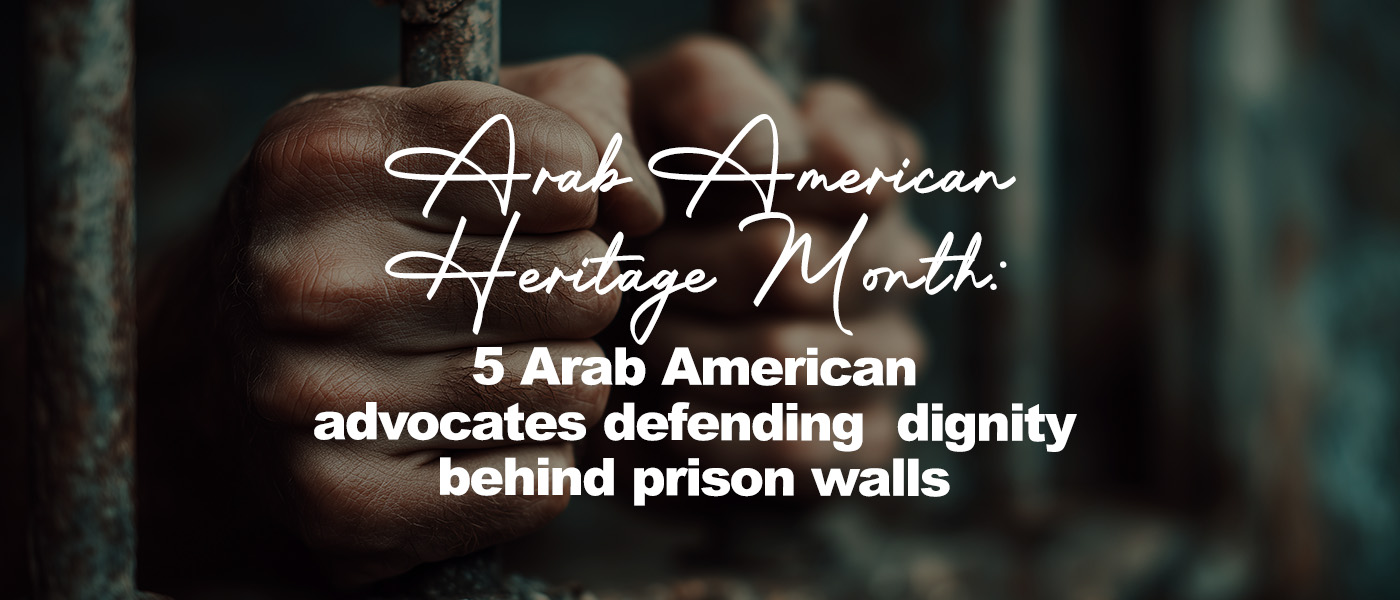
For generations, the story of prison advocacy in the United States has often been told through court rulings, policy debates, and headline-making reform campaigns. Yet beyond these formal arenas, some of the most persistent and transformative work has been carried forward by organizers whose names do not always enter mainstream conversation yet these are people who build trust across prison walls, challenge systems of exclusion, and insist that incarcerated people remain visible as members of the human community. Among them are Arab American advocates whose leadership has increasingly shaped conversations around dignity, religious freedom, civil rights, and minority protections inside state prisons. Their work emerges at a critical intersection where racial justice, immigrant identity, and faith-based advocacy meet one of the most neglected institutions in American public life. In many state prison systems, minority incarcerated populations, including Muslims, Black prisoners, immigrants, and speakers of non-English languages, continue to face barriers in access to worship, education, legal support, medical care, and culturally competent services.
Arab American advocates have often stepped into this space not only as civil rights defenders, but as bridge-builders, transforming legal systems, mobilizing community networks, and reframing incarceration as a moral issue that extends beyond punishment. What makes this leadership especially significant is that it frequently resists narrow advocacy. Many of these figures do not organize solely for Arab or Muslim prisoners, instead, they build coalitions that recognize how prison inequality affects multiple marginalized groups simultaneously. Their campaigns often connect the denial of halal meals to broader religious liberty concerns, solitary confinement to mental health justice, and family separation to deeper questions of state accountability.
For platforms like Islam in Prison, their stories matter because they reveal a larger truth that prison advocacy within Muslim and Arab American communities is not peripheral, it is part of a growing tradition of public moral leadership rooted in service, justice, and collective responsibility. At a time when prison reform conversations can become abstract or politically distant, these advocates remind us that change often begins with individuals willing to listen carefully, document injustice, and remain present where institutions would prefer silence.
This article highlights trailblazing Arab American figures whose advocacy has helped expand rights, visibility, and hope for minority communities inside state prisons. Indeed, these are leaders whose work deserves not only recognition, but wider study and great support.
Linda Sarsour’s voice in the struggle for religious freedom and prison equity
The first figure worth profiling is Linda Sarsour, whose public advocacy has consistently linked Muslim civil rights to broader struggles against over-policing, racial profiling, and mass incarceration. Long before her national visibility through the Women’s March, Sarsour was building local campaigns in New York that challenged the systems feeding minority communities into jail and prison, from opposing discriminatory surveillance of Muslim neighborhoods to supporting legislation aimed at curbing bias-based policing. Her work became especially influential because she refused to separate religious freedom from criminal justice. For Sarsour, the same structures that monitored Muslim communities outside prison often shaped how incarcerated Muslims were treated inside correctional institutions as well.
What makes her especially relevant to Islam in Prison is the way she has framed advocacy as a coalition work rather than identity politics alone. In speeches, organizing campaigns, and criminal justice reform partnerships, she has repeatedly argued that protecting Muslim prisoners’ dignity, whether through access to faith accommodations, family connection, or humane treatment, cannot be isolated from the rights of Black prisoners, immigrants, and other marginalized populations facing similar institutional neglect. That moral vocabulary of shared struggle is part of why her voice continues to resonate across prison reform circles. She speaks in a language that activists inside and outside prison recognize as both urgent and collective.
A voice shaped by experience: Khalil Cumberbatch’s prison justice leadership
Khalil Cumberbatch brings a perspective to prison advocacy that is both deeply personal and institutionally influential. A formerly incarcerated advocate of Arab American and Black heritage, he has become one of the most respected voices in national conversations on prison reform, particularly through his leadership with organizations focused on ending excessive punishment and expanding second-chance opportunities. What distinguishes Cumberbatch’s work is his insistence that prison policy must be shaped by people who understand incarceration not as theory, but as a lived reality. His advocacy has consistently challenged state systems that marginalize incarcerated people after release, especially those from communities already burdened by racial and economic inequality.
For Islam in Prison, his profile matters because he represents a form of leadership rooted in credibility, restraint, and moral clarity. Rather than framing reform only through legislative language, Cumberbatch often speaks about belonging. About how prisons sever social trust and how advocacy must rebuild it. His public work has supported campaigns around voting rights restoration, sentencing reform, and human treatment for incarcerated populations, while also broadening the conversation to include faith, family connection, and the long-term social consequences of exclusion. In doing so, he has helped redefine prison advocacy as not merely opposition to injustice, but a disciplined effort to restore dignity where systems have normalized its denial.
Nadia Ben-Youssef and her legal voice for those rarely heard
Nadia Ben-Youssef has built a respected body of work around civil rights advocacy that speaks directly to the conditions faced by marginalized communities under state control, including those affected by incarceration and detention. Through her leadership in constitutional rights campaigns, public legal advocacy, and efforts challenging discriminatory state practices, she has helped foreground how confinement often exposes deeper inequalities tied to race, religion, and national origin. Her work reflects a legal tradition that does not treat prison conditions as isolated administrative issues, but as part of a broader struggle over whether vulnerable populations receive equal protection under the law.
For Islam in Prison, Ben-Youssef’s significance lies in how her legal work broadens the understanding of Muslim and minority prisoner rights beyond religious accommodation alone. The same constitutional principles invoked in challenges to discriminatory detention practices, equal protection, due process, and freedom from cruel treatment, also shape how advocates defend incarcerated Muslims seeking dignity inside state prisons. Her voice reflects a growing generation of Arab American legal advocates who recognize that prison justice requires both courtroom strategy and public moral clarity, especially when minority communities are too often rendered invisible once they enter systems of confinement.
Abed Ayoub: Expanding civil rights advocacy across institutions
Abed Ayoub has emerged as one of the most visible Arab American civil rights leaders working to confront institutional discrimination affecting Arab and Muslim communities across the United States. As executive director of the American-Arab Anti-Discrimation Committee, his advocacy has focused on how public institutions, including schools, workplaces, law enforcement systems, and detention environments, shape the daily experience of minority rights. While much of his public work addresses broader anti-discrimination policy, its relevance to prison advoacy lies in the continuity he often highlights. The same patterns of bias that affect Arab and Muslim communities outside prison frequently reappear in correctional systems through unequal treatment, religious misunderstanding, and barriers to institutional accountability.
For Islam in Prison, Ayoub’s significance lies in his insistence that civil rights protections cannot stop at the prison gate. His public advocacy has repeatedly emphasized that constitutional protections remain meaningful not only when institutions are held accountable for how they treat people with the least public visibility. In that sense, his leadership contributes to a wider framework that prison advocates continue to draw upon. One in which religious identity, minority status, and human dignity remain inseparable from the broader language of civil rights.
Sua’d Abdul Khabeer on identity, power, and public recognition
Su’ad Abdul Khabeer’s work brings an important intellectual dimension to conversations about minority advocacy because she has consistently examined how race, religion, and state power shape the lives of Muslim communities in America. As a scholar and public commentator, her writing has helped illuminate the ways marginalized identities are interpreted, regulated, and often misunderstood within public institutions. While her work is not centered exclusively on prison systems, it offers a framework that many advocates draw upon when discussing why incarcerated Muslims often encounter both racialized and religious barriers inside state custody.
For Islam in Prison, her relevance lies in the clarity with which she names the social conditions that often precede incarceration and continue within confinement such as suspicion, invisibility, and unequal recognition. By examining how Black Muslim and immigrant Muslim identities are positioned within broader American narratives, Abdul Khabeer contributes to a deeper understanding of why prison advocacy for minority groups must also involve cultural literacy and public education. Her voice reminds readers that prison justice is not only about changing policy, but also about changing the assumptions society carries about whose dignity is easily protected and whose is routinely overlooked.
What these voices have made possible
What connects these figures is not a single method of advocacy, but a shared refusal to accept that marginalized people should disappear once they enter institutions of confinement. Some work through public mobilization, others through legal argument, institutional leadership, or intellectual inquiry, yet each contributes to a broader understanding that minority rights remain meaningful only when they are defended where visibility is weakest. In state prisons, where daily realities often unfold beyond public attention, that commitment carries particular weight.
For Muslim communities and other minority groups affected by incarceration, advocacy has never been limited to one profession or one public voice. It is built through coalitions, sustained by legal pressure, strengthened by scholarship, and often carried forward by individuals willing to insist that dignity is not conditional. For Islam in Prison, these stories matter not simply because they highlight achievement, but because they show that meaningful reform often begins with people who are prepared to widen the moral conversation, until those behind prison walls are recognized not as distant subjects of policy, but as members of the same human community.
Dua
May Allah (SWT) accept every sincere effort made in defense of dignity, strengthen those who speak on behalf of the vulnerable, and grant patience, protection, and hope to those living through confinement and separation.
May He (SWT) reward those who work for justice with wisdom and steadfastness, soften hearts where cruelty has taken root, and open paths toward mercy, fairness, and human dignity for all who remain behind prison walls.
May no sincere act of advocacy, compassion, or service go unseen by Him, and may every voice raised for what is right become a source of relief for those who are too often forgotten.
Ameen!